
Will My Piano Fit Through the Door? Piano Moving Through Narrow Doorways and Tight Spaces
Will My Piano Fit Through the Door? Piano Moving Through Narrow Doorways and Tight Spaces
One of the most common questions customers ask before a piano move is:
“Will my piano actually fit through the door?”
It is not a silly question at all.
Pianos are large, heavy and awkwardly shaped, and many homes throughout Melbourne have narrow front doors, hallways, tight turns, internal doors, verandas, steps and older access layouts that can make customers wonder whether the piano can physically get in or out.
The good news is that in most cases, an experienced specialist piano mover can assess the access and work out the safest way to complete the move.
JM & SONS Piano Movers has more than 40 years of experience moving upright, grand, baby grand, pianola and digital pianos through all kinds of Melbourne homes, including older inner-suburban properties where access can be tight.
Have questions about whether your piano will fit through a doorway or hallway? Contact JM & SONS Piano Movers and we’ll be happy to assess the access.
How Wide Does a Doorway Need to Be for a Piano?
There is no single doorway width that applies to every piano.
The answer depends on:
- the type of piano
- the piano’s width, depth and height
- whether it is an upright, grand, baby grand or digital piano
- whether the doorway can open fully
- whether there is room to turn before or after the doorway
- whether skirting boards, door handles or architraves reduce usable space
- whether the piano needs to be tilted or maneuvered at an angle
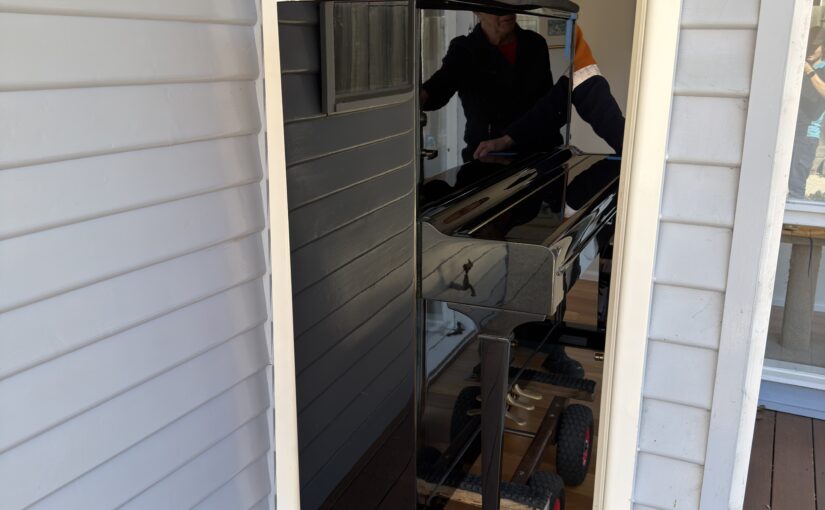
For many upright pianos, the piano can fit through a doorway that appears quite narrow because the instrument may be moved through on its side profile rather than simply pushed straight through as it sits in the room.
The exact method depends on the piano and access.
Is Piano Width the Most Important Measurement?
Not always.
Customers often measure only the width of the doorway and compare that with the width of the piano.
But professional movers look at more than one dimension.
We consider:
- piano width
- piano depth
- piano height
- doorway width
- doorway height
- hallway width
- ceiling height where relevant
- turning space
- corners
- landings
- steps
- floor levels
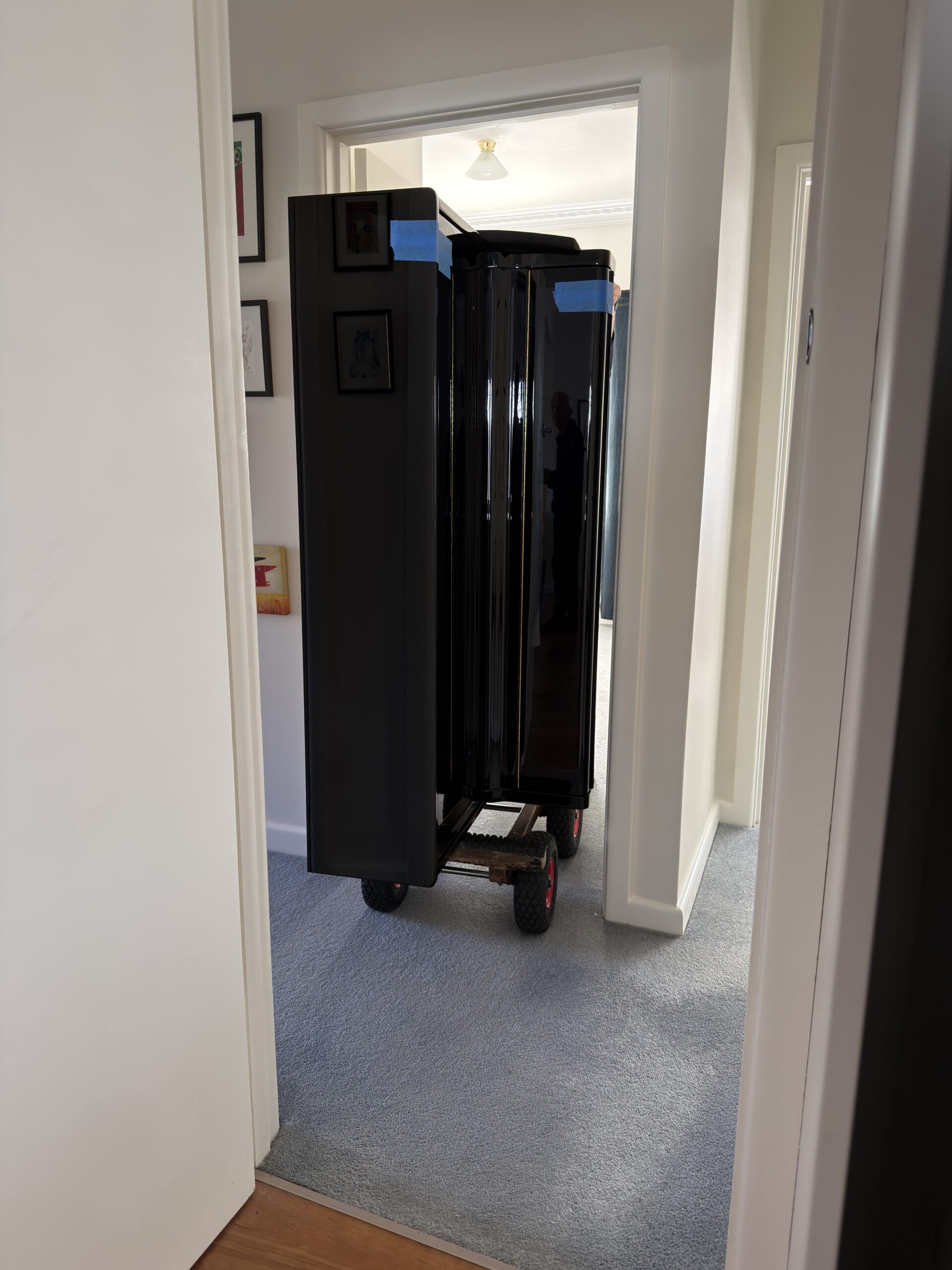
A piano may technically fit through a doorway but still be unable to make the turn immediately before or after it.
That is why photographs and access information are often more useful than one measurement on its own.
Can an Upright Piano Be Turned Sideways to Fit Through a Door?
Often, yes.
An upright piano is much wider across the keyboard than it is deep from front to back.
This means that in many situations, it can be carefully turned and moved through a doorway using its narrower dimension.
However, this needs to be done under control.
A piano is not like a normal cabinet.
It is heavy, top-heavy and delicate, with vulnerable corners, castors, pedals and cabinetry.
Trying to force it through a doorway without the correct equipment can result in:
- chipped piano corners
- damaged door frames
- scratched walls
- damaged floors
- trapped hands
- loss of balance
The fact that a piano can fit does not mean it should simply be pushed through.
What If the Doorway Is Very Narrow?
If access is unusually narrow, there are several things we assess before deciding how to proceed.
These can include:
- whether the door itself can be opened wider
- whether a removable door can safely be taken off its hinges
- whether door furniture reduces usable width
- whether the piano can be angled
- whether the piano can be tilted slightly
- whether a different entrance is better
- whether the garage offers easier access
- whether rear or side access is available
- whether internal doors create a better path
In many homes, the obvious front-door route is not necessarily the best route.
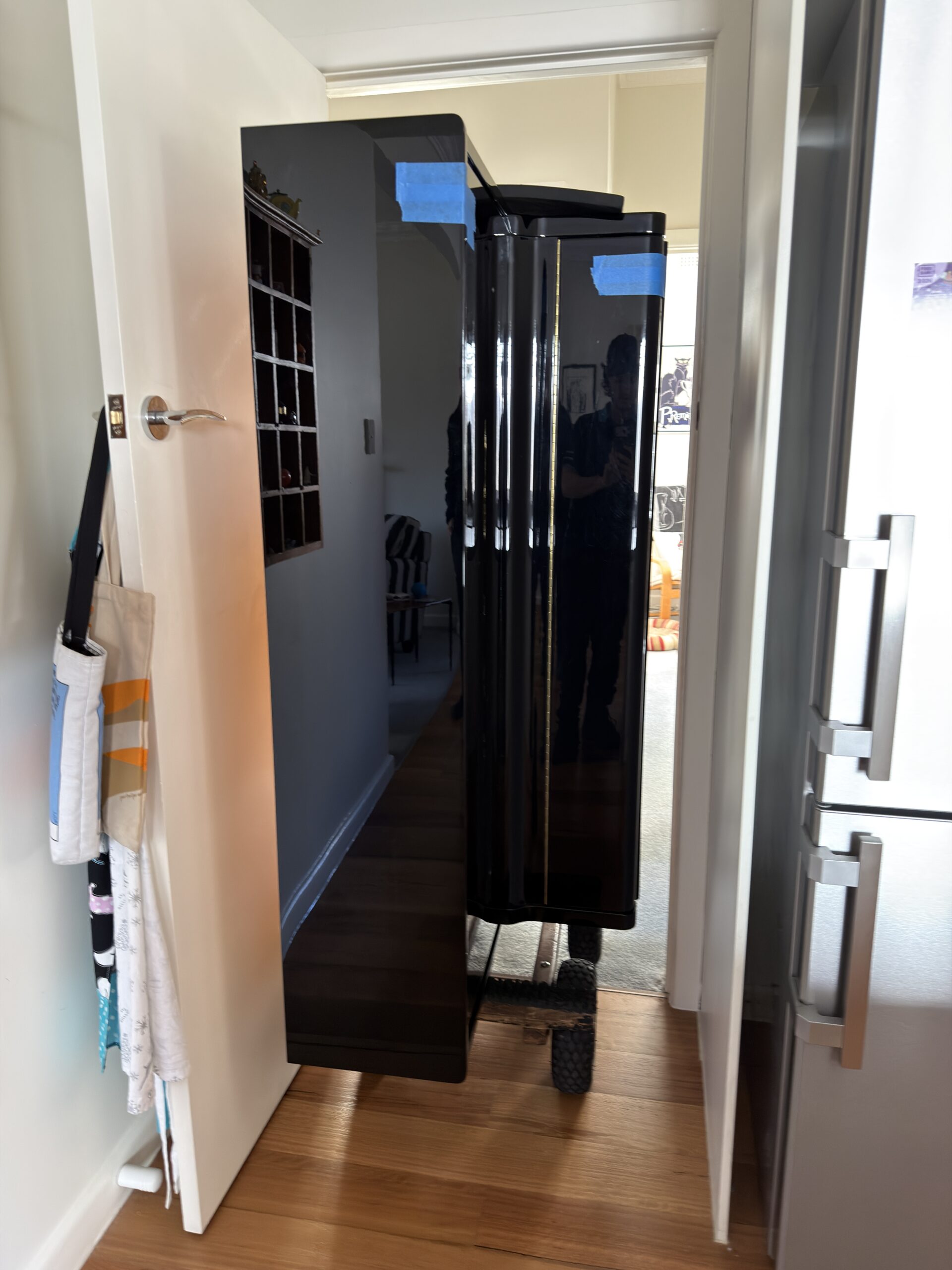
We look at the whole property.
Do You Ever Remove Doors?
Sometimes a door may need to be removed from its hinges to create additional usable space.
This is usually a straightforward property-access decision rather than part of the piano itself.
Whether this is needed depends on:
- the door design
- hinge type
- clearance
- piano dimensions
- whether removing the door genuinely improves the route
We do not recommend customers remove doors unnecessarily before the move unless we have discussed the access first.
In many cases, photographs are enough for us to advise whether it is likely to be needed.
What About Tight Hallways?
A hallway can be more important than the doorway.
A piano may pass through the front door but still need to negotiate:
- a narrow hall
- a sharp 90-degree turn
- a doorway immediately opposite another wall
- stairs
- a landing
- a change in floor level
- furniture or built-in cabinetry
This is where piano dimensions and turning space matter.
Experienced movers assess the piano as a three-dimensional object, not just a width measurement.
What If There Are 2–3 Steps at the Entrance?
Two or three straightforward entrance steps are common and generally part of normal piano-moving access.
They do not usually require special stair-work pricing or complex planning if they are:
- straight
- wide enough
- stable
- free from tight turns
- otherwise straightforward
JM & SONS routinely moves pianos over small entrance step sets using appropriate ramps and specialist equipment.
The bigger concern is usually not the number of steps but:
- how steep they are
- whether there is enough room to position equipment
- whether there is a landing
- whether there is a turn
- whether the doorway is immediately at the top or bottom
Is the Garage Often Easier Than the Front Door?
Sometimes, yes.
Garage access can be useful because it may offer:
- a wider opening
- fewer internal turns
- more direct trolley access
- easier ramp positioning
- fewer delicate door frames
However, every property is different.
A garage may also involve:
- a step up into the house
- narrow internal doors
- sloping floors
- storage obstacles
- tight corners
We often compare both routes and use whichever gives the safest access.
What Photos Should I Send Before the Move?
If you are worried about whether the piano will fit, send us clear photos of:
- the piano
- the front of the property
- the entrance doorway
- the hallway immediately inside
- any tight turns
- any stairs or steps
- garage access if available
- the final room where the piano will be positioned
Try to stand far enough back so the whole access area is visible.
A close-up of only the doorway may not show us whether the piano can turn before or after it.
Should I Measure the Doorway?
Yes, if access appears tight.
Useful measurements include:
- clear doorway width
- clear doorway height
- hallway width
- narrowest point
- distance from doorway to opposite wall
- stair width if relevant
For the piano, provide:
- overall width
- overall height
- overall depth
If you do not know the dimensions, a photograph and the piano make/model may be enough for us to estimate them.
Can You Tell From Photos Whether a Piano Will Fit?
Often, yes.
After thousands of moves, experienced piano movers can usually identify obvious access concerns from good photographs.
Photos can help us assess:
- doorway proportions
- turning space
- stair width
- landing size
- garage access
- obstructions
- likely equipment requirements
In some cases, we may still ask for measurements or additional photos.
For particularly difficult access, a video can be even more useful.
What If the Piano Is a Grand Piano?
Grand pianos are handled differently from upright pianos.
They are normally partially dismantled for transport.
Depending on the model, this can involve removing:
- legs
- pedal lyre
- music desk
- other transport-safe components where appropriate
The main piano body is then professionally protected and moved on specialist equipment.
Because of this, the size of a grand piano when it is sitting assembled in a room is not the same as the dimensions that matter when it is being moved through access.
For more information, read our guide on moving a grand piano safely.
Can a Baby Grand Fit Through a Standard Doorway?
Often, yes, because a baby grand is normally moved in a professionally dismantled transport configuration.
The piano body is handled on its side on specialist equipment.
Again, the important factors are:
- body dimensions
- doorway width
- ceiling height
- turning space
- stairs
- landings
- access before and after the doorway
The assembled appearance of the piano can make it look impossible to move, but professional transport methods change the geometry considerably.
What If the Piano Looks Too Big for the House?
This is surprisingly common.
Customers sometimes move into a house and assume the piano cannot possibly have come through the existing doorway.
But pianos can often be maneuvered in ways that are not obvious when looking at them in their final position.
That may involve:
- changing orientation
- tilting within safe limits
- removing a door
- using a different entrance
- dismantling a grand piano correctly
- using a ramp
- carefully controlling the piano through a turn
The solution usually comes from planning the whole route rather than looking at one doorway.
Can I Try to Move the Piano Through the Door Myself?
We do not recommend experimenting with a heavy piano in a tight doorway.
This is where many avoidable injuries and property-damage incidents occur.
Common problems include:
- getting the piano stuck
- chipping the cabinet
- damaging walls
- scratching floors
- damaging architraves
- losing control while turning
- tipping an upright
If the access is tight enough that you are uncertain whether the piano will fit, that is exactly when specialist assessment is most useful.
Why Piano Balance Matters in Tight Spaces
A piano’s weight is not distributed like ordinary furniture.
Uprrights in particular have a relatively high centre of gravity.
When the piano is turned, angled or tilted, the balance changes.
The mover needs to control:
- where the weight is going
- which part of the piano is supporting the load
- how much space is available
- where the next safe position is
This is why experience matters even when the move looks like “just getting it through a door.”
What About Protecting the Doorway and Walls?
We assess more than just whether the piano fits.
We also want to protect the property.
Depending on the access, this may involve:
- protective wrapping
- controlled trolley positioning
- floor protection
- careful turning technique
- additional personnel
- temporary removal of the door where appropriate
We also take video condition reports before handling so existing piano and property damage can be identified where relevant.
Do I Need to Worry About a 2–3 Step Entry?
Usually not.
For a standard upright piano and straightforward access, two or three entrance steps are normal working conditions for specialist piano movers.
You should still tell us about them when requesting a quote, but they are not the kind of access that would normally concern us by themselves.
What matters is whether those steps are:
- steep
- narrow
- uneven
- combined with a tight turn
- immediately beside a narrow doorway
What Information Should I Provide When Requesting a Quote?
To help us assess the move accurately, send:
- piano type
- make and model if known
- pickup suburb
- delivery suburb
- photographs of the piano
- photographs of pickup access
- photographs of delivery access
- number of steps
- photos of any tight doorway or hallway
- measurements if the doorway appears unusually narrow
- preferred moving timeframe
For straightforward access, this is usually enough for us to assess the job without a site visit.
Why Choose JM & SONS Piano Movers?
- Family-owned and operated
- More than 40 years of specialist piano-moving experience
- No outside contractors
- Experienced with narrow doorways, tight hallways and difficult access
- Specialist upright, baby grand and grand piano equipment
- Experienced with stairs, ramps and apartments
- Careful protection of floors, walls and doorways
- Video condition reports before handling
- Fully insured professional piano-moving service
- Trusted by Steinway Australia, Yamaha Australia and Kawai Australia
Request a Piano Moving Quote
If you are unsure whether your piano will fit through a doorway, do not worry.
Send us some photographs and measurements and we can usually assess the access before moving day.
Call JM & SONS Piano Movers on 0421 085 335.
Family-owned and operated — no outside contractors or inexperienced movers.
Trusted by Steinway Australia, Yamaha Australia and Kawai Australia for a reason.
Related Articles
Can You Move a Piano Upstairs?
Learn how stair width, landings, turns and piano dimensions affect an upstairs move.
How to Prepare for Your Upcoming Piano Move
A practical checklist covering parking, steps, pathways, pets and access before moving day.
How We Protect Timber Floors, Tiles and Carpet During a Piano Move
Learn how we protect floors from small castors, scratches, tram tracks and concentrated piano weight.