
How We Protect Timber Floors, Tiles and Carpet During a Piano Move
How We Protect Timber Floors, Tiles and Carpet During a Piano Move
One of the most common concerns customers have before a piano move is not the piano itself — it is the floor underneath it.
Customers regularly ask us:
- Can a piano damage timber floorboards?
- Can I roll a piano across polished floors?
- Will a heavy upright crack tiles?
- Can piano wheels damage carpet?
- What happens if the piano’s castors are seized?
- How do professional piano movers protect newly polished floors?
- Can a piano be safely moved across old or uneven floorboards?
After more than 40 years of specialist piano moving, JM & SONS Piano Movers has worked across virtually every type of household flooring — polished timber, old pine boards, hardwood, tiles, carpet, floating floors, concrete and everything in between.
In our experience, the main risk is usually not whether the floor can support the stationary piano.
The greater risk is what happens while 200–300 kg or more is being moved across that floor.
That is where experience, equipment and attention to detail matter.
Have questions about protecting your floors during a piano move? Contact JM & SONS Piano Movers and we’ll be happy to help.
Why Piano Castors Can Damage Floors
Most upright pianos sit on small castors.
Depending on the piano, these may be:
- brass;
- steel or other metal;
- very narrow;
- worn;
- rusted;
- seized;
- partly collapsed;
- difficult to rotate;
- decades old.
A standard upright piano may weigh around 200–250 kg or more.
When that weight is concentrated through only a few small metal castors, each castor creates a very small but heavily loaded contact point.
That is why simply pushing an upright piano across a timber floor can cause significant damage.
We regularly see:
- scratches;
- dents;
- parallel wheel marks;
- compressed timber;
- damaged floor coatings;
- torn carpet;
- chipped tiles;
- marks around thresholds.
The parallel marks left by piano castors are something we often describe as tram tracks.
In older Melbourne homes, particularly where softer pine floorboards have been used, these marks can be very noticeable.
Why Old Piano Castors Are Particularly Dangerous
A customer may assume:
“The piano has wheels, so surely it is designed to roll.”
Unfortunately, piano castors are not the same as modern furniture wheels.
Some old castors barely move.
Others may turn partially and then seize.
A completely seized castor can effectively behave like a small piece of metal being dragged across the floor underneath hundreds of kilograms of piano.
Even a castor that appears to roll can catch:
- between floorboards;
- on tile grout;
- at doorway thresholds;
- against carpet joins;
- on uneven timber;
- on small changes in floor height.
That is why we do not rely on the piano’s original wheels to transport it through the property.
Can You Roll a Piano Across Timber Floorboards?
We generally advise against rolling a heavy upright directly across timber flooring on its own castors.
The risk depends on:
- the weight of the piano;
- castor condition;
- timber type;
- floor finish;
- age of the boards;
- whether the floor is level;
- whether individual boards are damaged;
- how far the piano needs to travel.
Soft pine flooring is particularly vulnerable.
Harder timber may resist denting better, but a small piece of grit trapped beneath a trolley, wheel or protective surface can still scratch a polished finish.
Professional floor protection is therefore important even when the timber itself is strong.
How JM & SONS Gets a Piano Off Its Castors Without Damaging the Floor
Once we have assessed the piano and the flooring, our aim is to get the piano onto specialist moving equipment without dragging or rolling its original castors across the floor.
For upright pianos, we use a purpose-built piano trolley designed to carry the piano’s weight more safely and evenly than the small original castors.
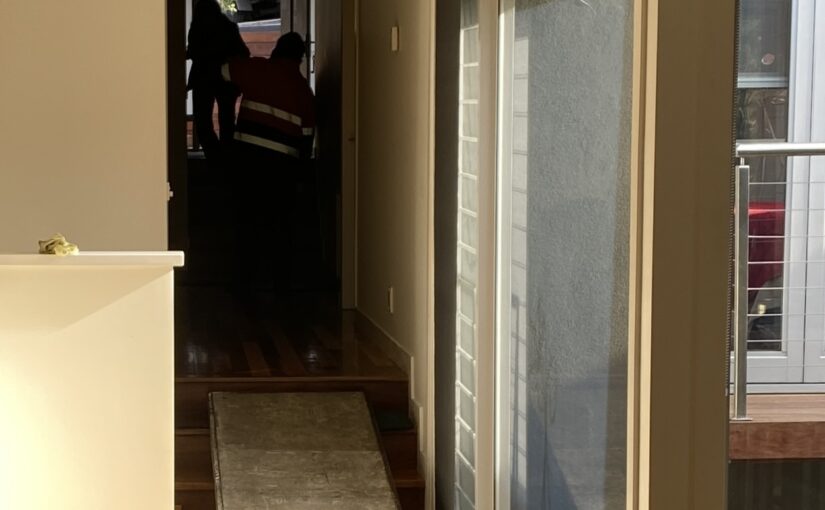
Where there are a small number of steps or a slight level change, we may also use a ramp to create a controlled path for the piano.
To protect timber floors, tiles and other delicate surfaces, we place protective coverings beneath the ramp at the contact points. These coverings help:
- prevent the ramp from marking or scratching the floor
- spread the load at the ramp contact points
- reduce direct pressure on polished timber or tiles
- provide a cushioning effect as the piano passes over a short set of steps
- help keep the ramp stable while the piano is moved
This is particularly important in older Melbourne homes with polished or softer timber floorboards, where a heavy piano or unprotected ramp can leave dents, scratches or pressure marks.
The key is to control the piano’s weight before it travels across the floor, rather than relying on its original castors and hoping they roll freely.
That is why we use specialist trolleys, ramps and floor protection as part of the moving setup.
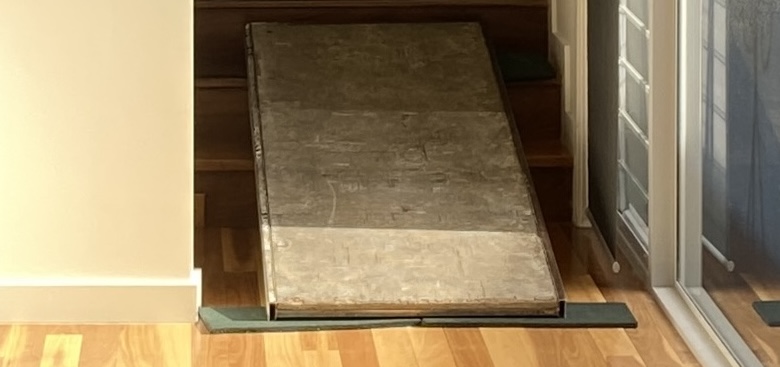
Protective coverings placed beneath the ramp help protect polished timber floors and cushion the contact points during a short-step piano move.
What Are “Tram Tracks” on Timber Floors?
Tram tracks are the parallel marks often left when a piano has previously been rolled across timber flooring.
Because upright pianos commonly have castors positioned at each end, the marks can appear as two or more straight lines running across the floor.
We see these regularly in older homes.
They are often evidence of:
- previous DIY piano moving;
- inexperienced removalists;
- castors being dragged rather than rolled;
- repeated repositioning over many years.
Sometimes customers have lived with the marks for so long that they no longer notice them.
Before we begin handling a piano, we are mindful of identifying existing damage so there is no confusion later about when or how it occurred.
Why We Take a Video Condition Report Before Moving
Our video condition report is not only about the piano.
It can also help document the surrounding property.
Where relevant, we may note or record:
- existing floor scratches;
- dents;
- cracked tiles;
- damaged carpet;
- wall marks;
- chipped doorways;
- damaged steps;
- existing piano cabinet damage.
This protects both the customer and our team.
It also gives us an opportunity to point out damage that the customer may not previously have noticed.
Our objective is straightforward:
identify what is already there and make sure we do not make it worse.
Can a Piano Damage Polished Timber Floors?
Yes, particularly during movement.
A stationary piano on a normal structurally sound floor is generally not a problem.
The danger comes from:
- dragging seized castors;
- turning the piano directly on small wheels;
- grit trapped beneath equipment;
- dropping one corner;
- pushing too much weight onto one contact point;
- using unsuitable trolleys.
Freshly polished floors require particular care because even a minor scratch can be very noticeable.
If a piano has been removed for sanding or polishing, we generally recommend having it professionally returned once the flooring work is complete.
The return move across the newly finished floor deserves just as much care as the removal.
How Do We Protect Newly Finished Floorboards?
Before crossing a polished or recently refinished floor, we consider:
- floor cleanliness;
- whether there is grit or building residue;
- the route through the property;
- turns and doorways;
- thresholds;
- trolley positioning;
- piano weight and balance.
We use suitable protection between our moving equipment and the finished surface where required.
One important detail is keeping the equipment itself clean.
A trolley wheel may be perfectly suitable for a polished floor, but if mud or grit has been carried in from outside and becomes trapped underneath it, that contamination can act like sandpaper.
That is why floor protection is not simply a matter of putting something under the piano.
The entire access route needs to be considered.
Why Mud and Grit Matter During a Piano Move
On wet days, small amounts of soil, gravel or grit can easily be carried inside.
This is particularly important when moving between:
- driveways and timber floors;
- garden paths and carpet;
- gravel access and tiles;
- outdoor steps and polished interiors.
When a loaded piano trolley turns, even a tiny piece of abrasive grit beneath a wheel can mark a floor.
Our team is therefore conscious of keeping the indoor route as clean as practical and using protection where needed.
Customers can also help by keeping paths, entrances and indoor flooring clear and dry before the movers arrive.
Can a Piano Crack Tiles?
A piano can damage tiles if its weight is concentrated incorrectly or the tiles already have weaknesses.
Potential risks include:
- cracked or loose tiles;
- hollow areas beneath tiles;
- narrow metal castors;
- impact when crossing grout lines;
- dropping or jolting a piano;
- concentrated pressure on one point.
The objective is to distribute and control the piano’s weight rather than allowing a small metal castor to take the load directly.
We also inspect the intended route for existing cracked or unstable tiles where they are obvious.
Can Piano Wheels Damage Carpet?
Yes.
Carpet often appears forgiving, but piano castors can create problems, particularly if they are seized.
Dragging a heavy piano across carpet may:
- tear fibres;
- stretch the carpet;
- damage backing;
- catch at joins;
- leave deep tracks;
- pull newly laid carpet out of position.
Older carpet can also be brittle.
New carpet may be more vulnerable because customers understandably want it kept perfect.
For carpet installation, we generally recommend professional removal of the piano before the work and professional replacement afterward.
Should Carpet Layers Move a Piano?
Many carpet installers and flooring contractors prefer not to move pianos.
That is understandable.
Their expertise is flooring — not controlling a heavy musical instrument.
A piano may be the heaviest object in the room, and damage caused while moving it can affect:
- the piano;
- the new carpet;
- walls;
- doorways;
- workers.
Having a specialist piano mover handle the instrument before and after flooring work removes that responsibility from the flooring contractor.
What About Floating Floors and Engineered Flooring?
Floating and engineered floors require care because the visible surface may sit over an underlay rather than being fixed directly to structural flooring in the same way as traditional boards.
Heavy point loads and dragging can potentially:
- dent the surface;
- damage locking joints;
- scratch the finish;
- cause movement at joins.
The important issue is again weight distribution and controlled movement.
Tell your piano mover if the floor is newly installed or if you know it is a floating system.
Can Uneven Floorboards Make a Piano Unstable?
Yes.
Older homes can have floors that are:
- sloping;
- warped;
- uneven;
- affected by ageing stumps;
- awaiting restumping;
- locally damaged.
A piano placed on an uneven surface may rock or lean.
This requires particular attention with some upright designs because the piano may have limited support at the front.
If a piano is noticeably unstable after positioning, the customer needs to be made aware.
In some cases, suitable chocking or levelling may be required so that the piano remains secure.
A piano that is rocking should not simply be ignored.
Can an Uneven Floor Make a Piano Tip?
Potentially.
Pianos have a high centre of gravity, especially tall upright models.
A badly uneven floor combined with unsuitable positioning can make an upright less stable than expected.
This is particularly important in homes with children.
After placing a piano, we look at how it sits rather than assuming that because it is stationary it must automatically be safe.
If there is a stability concern, we discuss it with the customer.
What If the Floorboards Are Cracked or Damaged?
Existing floor damage should be identified before placing the piano over it.
Examples include:
- cracked boards;
- loose boards;
- missing boards;
- rotten timber;
- damaged joins;
- soft sections;
- old repairs.
JM & SONS has moved pianos into and out of some extremely challenging older properties, including houses requiring restumping and properties with missing or damaged floorboards.
Most normal floor irregularities can be managed with planning and experience.
However, if the floor appears structurally unsafe, that is different.
A piano mover cannot certify the structural integrity of a building. Serious structural concerns should be assessed by an appropriately qualified building professional before a heavy piano is placed there.
What About Floor Heating Vents?
Floor vents are another detail that can easily be overlooked.
A heavy piano should not be positioned so that substantial weight rests directly on a fragile heating vent or grille.
Similarly, a trolley carrying a piano should not be driven directly across a weak vent where the concentrated load could collapse it.
We look at the full route and final position, not just whether the piano physically fits into the room.
Can a Piano Be Placed Against a Wall on a Sloping Floor?
Care is required.
If the floor slopes toward the wall, the piano may lean more heavily than expected.
This could:
- mark the wall;
- damage plaster;
- make the piano unstable;
- put inappropriate pressure on part of the cabinet.
Older houses sometimes have more floor movement and variation than customers realise.
The final position needs to be considered after the piano is placed.
Does the Weight of the Piano Mean My Floor Will Collapse?
For the overwhelming majority of normal residential properties we encounter, no.
Customers often overestimate the structural issue and underestimate the surface-damage issue.
The fact that a piano weighs 200–300 kg does not normally mean that an ordinary serviceable residential floor cannot support it.
The greater practical concern is often the concentration of that weight through tiny castors while the piano is being moved.
If a floor has serious rot, missing supports, major structural failure or other known defects, professional building advice may be appropriate.
But in our experience over thousands of piano moves, a normal floor supporting a normal piano is rarely the problem customers imagine it will be.
For more information about piano weight, read our guide: How Much Does a Piano Weigh?
Can I Move My Piano Across the Floor Myself?
Sometimes a piano can physically be repositioned by a homeowner on level ground.
That does not mean it is risk-free.
Common DIY problems include:
- castor marks;
- scratches;
- chipped piano cabinets;
- damaged doorways;
- torn carpet;
- unstable pianos;
- crushed fingers;
- tipping.
If the piano only needs to move a short distance for flooring or renovation work, the distance does not make the instrument lighter.
A 250 kg upright moved two metres is still a 250 kg upright.
If the floor is valuable, newly finished or delicate, professional repositioning can be inexpensive compared with repairing damaged flooring.
Are Piano Moving Trolleys Safe on Timber Floors?
The correct trolley, used properly, can allow a piano’s weight to be moved much more safely than relying on the piano’s original castors.
But the trolley is only one part of the process.
The mover must also consider:
- floor protection;
- wheel cleanliness;
- turning technique;
- thresholds;
- balance;
- load distribution;
- access width.
Even professional equipment can cause damage if it is dirty, incorrectly loaded or used without care.
Experience matters just as much as owning the equipment.
Why Experience Matters Around Delicate Floors
After thousands of moves, experienced piano movers begin noticing things before the piano moves at all.
We look for:
- existing tram tracks;
- warped boards;
- damaged floor finishes;
- cracked tiles;
- loose carpet;
- floor vents;
- thresholds;
- uneven levels;
- mud and grit;
- turning space;
- unstable piano positioning.
These details may seem minor, but they are often the difference between a routine move and unnecessary property damage.
JM & SONS has spent more than 40 years encountering these situations in real homes.
That first-hand experience is difficult to replace with general furniture-moving knowledge.
How Customers Can Prepare Their Floors Before We Arrive
You can help protect the property by:
- clearing furniture from the piano route;
- keeping floors clean and dry;
- removing loose rugs where appropriate;
- keeping garden paths free from mud;
- telling us about newly polished floors;
- advising us about cracked tiles or damaged boards;
- identifying underfloor heating vents;
- mentioning recent carpet installation;
- keeping children and pets away from the moving route.
If there is anything unusual about the flooring, tell us before moving day.
Photos are particularly helpful where there are damaged boards, uneven flooring, unusual thresholds or delicate surfaces.
For a complete preparation checklist, read How to Prepare for Your Upcoming Piano Move.
What If Existing Floor Damage Is Already Present?
Do not worry.
Existing damage does not necessarily prevent the piano from being moved.
Our first priority is to identify it.
Where relevant, we document the area and discuss it with the customer before proceeding.
This helps prevent misunderstandings and allows us to adapt the moving method if the damaged area needs to be avoided.
The same principle applies to existing damage on the piano itself.
Why Choose JM & SONS Piano Movers?
- Family-owned and operated — no outside contractors
- More than 40 years of specialist piano-moving experience
- Thousands of residential and commercial piano moves
- Experienced with polished timber, pine boards, tiles, carpet and delicate flooring
- Specialist piano trolleys, skids, ramps and floor protection
- Experienced with damaged, uneven and older floors
- Video condition reporting before handling
- Careful assessment of both the piano and surrounding property
- Fully insured professional piano-moving service
- Trusted by Steinway Australia, Yamaha Australia and Kawai Australia
Request a Piano Moving Quote
To request a quote, please provide:
- piano type;
- pickup and delivery suburbs;
- photographs of the piano;
- photographs of stairs or difficult access;
- details of any delicate, newly installed or damaged flooring;
- your preferred moving timeframe.
If your floors have recently been polished, sanded, tiled or carpeted, let us know when requesting the quote.
Call JM & SONS Piano Movers on 0421 085 335.
Family-owned and operated — no outside contractors or inexperienced movers.
Trusted by Steinway Australia, Yamaha Australia and Kawai Australia for a reason.
Related Articles
How Much Does a Piano Weigh?
Understand typical upright, grand and digital piano weights and why weight distribution matters during a move.
Read our piano weight guide
How to Prepare for Your Upcoming Piano Move
Prepare parking, pathways, rooms, steps and property access before the moving team arrives.
Read our piano-moving preparation checklist
Can You Move a Piano Upstairs?
Learn how stairs, landings, turns, piano weight and access affect an upstairs move.
Read our guide to upstairs piano moving
How to Move a Piano Across Gravel or Uneven Ground
Learn why original piano castors should not be used across gravel and how specialist equipment helps.
Read our gravel and uneven-access guide