
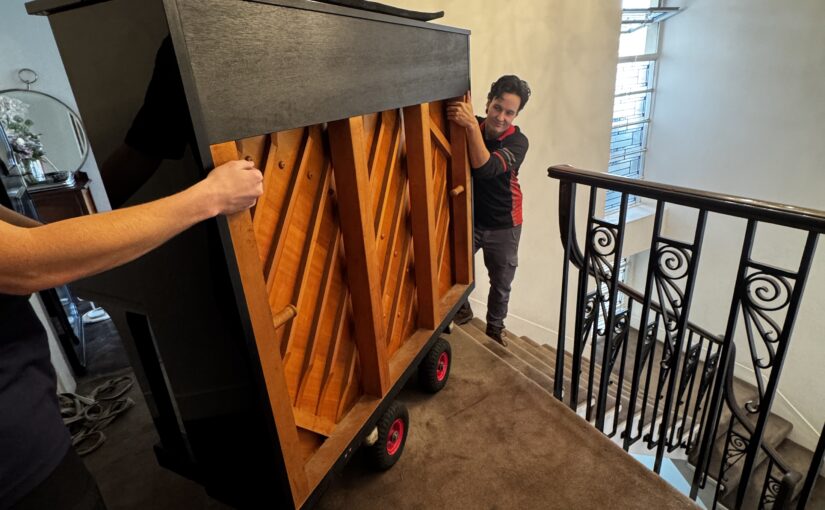
How Much Does a Piano Weigh? Upright, Grand & Digital Piano Weight Guide
How Much Does a Piano Weigh? Upright, Grand & Digital Piano Weight Guide
One of the most common questions we are asked before a piano move is:
How much does my piano weigh?
The question is usually not just about curiosity. Most customers are really trying to work out one of three things:
- Will my floor safely support the piano?
- Can I move the piano myself?
- Why does a piano require specialist movers and equipment?
After more than 40 years of moving pianos throughout Melbourne and Victoria, JM & SONS Piano Movers has handled instruments in almost every type of property and on almost every type of floor.
Pianos are certainly heavy, but their weight is generally not something homeowners need to be frightened of. The greater issue is how that weight is controlled and distributed while the piano is being moved.
Have questions about the weight of your piano or an upcoming move? Contact JM & SONS Piano Movers and we’ll be happy to help.
How Much Does a Piano Weigh?
Piano weight varies considerably according to the type, size, age and construction of the instrument.
As a practical guide:
- Portable and smaller digital pianos: approximately 20–60 kg
- Console and cabinet digital pianos: approximately 50–100+ kg
- Digital grand pianos: approximately 80–170+ kg
- Small acoustic uprights: approximately 170–220 kg
- Standard upright pianos: approximately 200–250 kg
- Large professional uprights: approximately 240–300+ kg
- Pianolas and player pianos: approximately 250–350+ kg
- Baby grand pianos: approximately 220–300 kg
- Medium grand pianos: approximately 280–400 kg
- Large and concert grand pianos: approximately 400–500+ kg, with some particularly large instruments approaching or exceeding 500 kg
These are approximate ranges only. Individual models can fall outside them.
The exact weight is useful, but for professional piano movers the dimensions, balance, access and construction of the piano are just as important as the figure on the specification sheet.
Why Are Pianos So Heavy?
An acoustic piano contains a substantial amount of timber, metal and mechanical components.
The majority of the weight comes from:
- the cast-iron frame or plate;
- strings under considerable tension;
- the timber cabinet;
- the soundboard;
- the keyboard and action;
- pedals and supporting structure.
A large upright may weigh more than some baby grands.
Pianolas can also be considerably heavier than ordinary uprights because they contain additional player mechanisms.
Digital pianos do not contain the same heavy iron plate and string system, so they are generally lighter. However, large digital grands can still be bulky, awkward and delicate instruments requiring careful handling.
Will My Floor Support the Weight of a Piano?
This is one of the biggest concerns customers raise with us.
In our experience, the overwhelming majority of normal residential floors can support a piano without difficulty.
Over more than four decades, JM & SONS has moved pianos into and out of:
- timber-floored homes;
- tiled properties;
- carpeted rooms;
- apartments;
- period homes;
- houses awaiting restumping;
- properties with damaged or missing floorboards;
- older homes with noticeably uneven floors.
We have encountered some extremely poor access and flooring conditions over the years, but problems caused simply by the stationary weight of a normal piano are very uncommon.
A piano may weigh 200, 250, 300 kilograms or more, but that does not mean the floor is suddenly carrying all of that weight in one unsupported location.
A properly constructed residential floor spreads loads through the floorboards, joists and supporting structure.
Of course, if a floor is known to be structurally unsafe, rotten, badly damaged or unsupported, it should be assessed before placing any heavy object on it. But for a normal home in serviceable condition, customers generally do not need to worry that their piano is simply going to fall through the floor.
The Bigger Risk Is Often Floor Damage While the Piano Is Moving
The weight of the piano itself is usually not the main problem.
The problem is that an upright piano may be sitting on only four small castors.
If a 250 kg piano has its weight distributed across four castors, a substantial amount of load is concentrated at each small contact point.
Those castors are often:
- narrow;
- metal;
- old;
- seized or difficult to turn;
- unsuitable for travelling across household flooring.
Rolling a heavy piano directly across polished timber can leave the characteristic parallel marks we sometimes call tram tracks.
We regularly see this after pianos have been moved by people without the correct equipment.
Similar damage can occur to:
- timber floors;
- floating floors;
- vinyl;
- tiles;
- new carpet;
- polished concrete;
- thresholds and joins.
This is why professional piano movers do not simply push a piano across the room on its own castors.
Are Piano Castors Designed for Moving the Piano Around the House?
Not really.
Piano castors are useful for very small positional adjustments, but they should not be treated like furniture wheels designed for transporting the piano through the house.
An old upright piano may have very small metal castors that have not moved freely for decades.
Trying to push the piano across a timber floor can:
- mark the finish;
- dent soft timber;
- scratch boards;
- catch between floorboards;
- damage carpet;
- cause the piano to become unstable.
Professional movers use specialist equipment so the piano’s weight is supported and controlled rather than concentrated through its small original castors.
Can a Piano Damage Tiles?
Yes, particularly while it is being moved incorrectly.
Tiles themselves can be strong, but a heavy piano sitting or rolling on a very small castor creates concentrated point loading.
The risk may be greater where:
- a tile is already cracked;
- there is a hollow area beneath the tile;
- the castor catches on a grout line;
- the piano is dropped or jolted;
- excessive force is applied to one corner.
Our equipment is designed to distribute the piano’s load more effectively and allow controlled movement across delicate surfaces.
Can a Piano Damage Carpet?
A stationary piano will normally leave impressions in carpet, which is expected with any heavy piece of furniture.
The greater risk comes when moving the piano.
Dragging or rolling a heavy piano directly across carpet can:
- stretch the carpet;
- damage the backing;
- catch the castors;
- make the instrument unstable;
- damage newly laid carpet.
If customers are having new carpet installed, we generally recommend having the piano professionally removed beforehand and professionally returned after the work is finished.
It is often the return move onto the new flooring where extra care matters most.
What About Newly Polished or Refinished Timber Floors?
This is another situation where we recommend professional handling.
Customers often arrange for a piano to be moved out while timber floors are sanded, polished or refinished.
Once that work is complete, bringing a 200–300 kg piano back across the newly finished surface needs to be done carefully.
Even if someone successfully moved the piano out themselves, returning it across a new floor is where one mistake can cause expensive damage.
JM & SONS uses appropriate moving equipment and established techniques to protect both the piano and the finished surface.
Can I Move a Piano Myself?
Technically, some people can reposition a piano themselves on level ground.
But whether they should is another question.
If there are stairs, steep slopes, awkward steps or significant level changes involved, we strongly recommend using professional piano movers.
Moving a heavy piano on stairs without the appropriate equipment and experience can be extremely dangerous.
Even on level floors, risks include:
- damaging the floor;
- tipping the piano;
- damaging the cabinet;
- trapping fingers;
- damaging door frames;
- losing control on thresholds;
- damaging the piano’s legs or castors.
An upright piano has a relatively high centre of gravity and can become unstable surprisingly quickly if it is tipped or twisted incorrectly.
A small mistake can take a sizeable chip out of an otherwise excellent piano.
Why Do Upright Pianos Tip More Easily Than People Expect?
An upright piano may look like a large solid cabinet, but much of its mass sits relatively high above the floor.
When the piano is tilted, pushed sideways or catches on an obstacle, its weight can shift rapidly.
That is why experienced piano movers control the instrument from the correct points and use equipment designed specifically for the task.
Pushing on the wrong section of the cabinet or trying to force a castor over an obstacle can destabilise the piano.
Can I Just Move the Piano a Metre or Two for New Carpet or Flooring?
Possibly, but this is exactly where a great deal of floor damage occurs.
People often think:
“It only needs to move across the room.”
The distance may be short, but the piano is still just as heavy.
If it is rolled directly on its castors, even a short movement can scratch timber or damage carpet.
For flooring work, renovations or room changes, JM & SONS can:
- move the piano out of the working area;
- reposition it elsewhere in the home where practical;
- remove it temporarily;
- return it after the flooring work is complete.
We particularly recommend professional repositioning when the new floor or carpet has just been installed.
Why Won’t My Furniture Removalist Move My Piano?
Many general furniture removalists now decline piano work altogether.
Pianos are:
- unusually heavy;
- difficult to balance;
- expensive to repair;
- easily damaged;
- capable of damaging property;
- difficult to handle safely on stairs.
Carpet layers, flooring contractors and other tradespeople also generally do not want responsibility for moving a piano.
They may be experts in their own field, but moving a 250 kg piano is not part of their normal work.
A specialist piano mover arrives with the equipment, experience and insurance appropriate to the job.
Why Does Piano Weight Matter on Stairs?
Stairs change everything.
A 250 kg upright on level ground is one situation.
The same piano on a staircase is completely different.
The movers must control:
- the piano’s full weight;
- gravity;
- balance;
- stair width;
- landing dimensions;
- tight turns;
- handrails;
- floor and wall protection;
- available lifting positions.
The piano may also need to be tilted or manoeuvred in ways that dramatically change its centre of gravity.
This is one reason we strongly advise against DIY stair moves.
For more information, read our guide: Can You Move a Piano Upstairs?
Does Removing the Legs Make a Grand Piano Light?
Removing the legs, pedals and lyre from a grand piano does reduce some weight, but the main body of the piano remains extremely heavy.
Most of the grand piano’s weight is contained in:
- the cast-iron plate;
- strings;
- soundboard;
- cabinet;
- action;
- keyboard assembly.
The purpose of professionally dismantling a grand piano is primarily to make it safer and more manageable for transport—not to turn it into a lightweight object.
A grand piano body still requires specialist equipment and controlled handling.
Is a Baby Grand Lighter Than an Upright?
Not always.
A smaller baby grand may weigh around the same as a large upright.
A tall professional upright can sometimes be surprisingly heavy because of:
- its large cast-iron plate;
- substantial timber casework;
- longer strings;
- stronger internal structure.
This is why we prefer customers to provide the piano make, model and approximate dimensions rather than simply telling us that it is an “upright” or “grand.”
Are Pianolas Heavier Than Normal Upright Pianos?
Usually, yes.
Traditional player pianos and pianolas contain additional mechanical systems inside the cabinet.
This extra equipment can make them significantly heavier, wider and overall much larger than a conventional upright.
They can also have a different balance, which affects how they should be handled.
Always tell your mover if the piano is a pianola or player piano.
How Do I Find Out the Exact Weight of My Piano?
The easiest method is to identify:
- manufacturer;
- model;
- serial number;
- approximate dimensions.
Manufacturer specifications may provide the exact weight.
If you cannot identify the model, send us:
- a photograph of the complete piano;
- a photograph of the manufacturer’s name;
- model or serial-number details if visible;
- upright height or grand length.
In many cases, an experienced piano mover can estimate the likely weight range from the piano’s type, dimensions and construction.
For quoting purposes, exact weight is often less important than identifying the piano correctly and understanding the access.
Does JM & SONS Need the Exact Piano Weight Before a Move?
Usually not.
Knowing the approximate type and size of the piano is generally enough for us to determine the likely weight range and appropriate equipment.
The access information is often equally important.
We need to know about:
- steps;
- stairs;
- narrow doorways;
- tight turns;
- gravel;
- slopes;
- long carries;
- apartment lifts;
- loading bays;
- delicate flooring.
A 220 kg piano with straightforward access may be easier to move than a lighter instrument positioned at the top of a difficult staircase.
Why Piano Weight Is Only Part of the Story
Customers understandably focus on the number of kilograms.
Professional movers look at the complete situation.
We consider:
- weight;
- dimensions;
- balance;
- centre of gravity;
- piano type;
- flooring;
- stairs;
- access;
- carrying distance;
- available turning space;
- truck access;
- final position.
That is why two pianos of similar weight can require completely different moving methods.
How JM & SONS Protects Your Floors
Over more than 40 years of specialist piano moving, we have developed practical methods for moving pianos across a wide variety of surfaces.
Depending on the property and piano, we may use:
- specialist piano trolleys;
- piano skids;
- protective pads;
- heavy-duty wraps;
- ramps;
- floor protection;
- controlled lifting and repositioning techniques.
The aim is not simply to get the piano from one place to another.
We need to protect:
- the piano;
- timber floors;
- carpet;
- tiles;
- walls;
- doors;
- thresholds;
- the surrounding property.
In our experience, customers generally do not need to worry about whether a normal floor can hold their piano. They should be more concerned about how the piano is moved across that floor.
Should I Have My Piano Professionally Removed Before Flooring Work?
We recommend it.
If you are:
- replacing carpet;
- sanding timber floors;
- polishing floorboards;
- installing tiles;
- renovating;
- repairing flooring;
it is usually safer to move the piano properly before the work begins.
We also recommend having the piano professionally returned once the floor work is complete.
New flooring is often more vulnerable to damage because customers are understandably trying to keep it pristine.
What Is the Heaviest Piano JM & SONS Can Move?
Large concert grand pianos can approach or exceed 500 kg depending on the instrument.
The total weight alone does not determine whether a piano can be moved.
The more important questions are:
- Can the property be accessed safely?
- Is there enough room to manoeuvre the piano?
- Are stairs or landings suitable?
- Can the appropriate equipment be used?
- Is there sufficient truck access?
- Can the job be completed without unacceptable risk to the instrument or property?
Very large pianos require careful planning, but they are part of specialist piano-moving work.
Why Use Specialist Piano Movers?
A piano is not simply heavy furniture.
It is a musical instrument with:
- considerable weight;
- delicate cabinetry;
- complex internal components;
- unusual balance;
- small castors;
- limited safe handling points.
Professional piano movers understand how these factors interact.
Using specialists helps reduce the risk of:
- scratched floors;
- damaged carpet;
- chipped cabinetry;
- damaged walls and doorways;
- unstable lifting;
- uncontrolled movement;
- personal injury.
Why Choose JM & SONS Piano Movers?
- Family-owned and operated — no outside contractors
- More than 40 years of specialist piano-moving experience
- Experienced with upright, grand, baby grand, pianola and digital pianos
- Specialist equipment for heavy and difficult piano moves
- Experienced with stairs, apartments and difficult access
- Careful protection of timber floors, tiles, carpet and property
- Video condition reports before handling
- Fully insured professional piano-moving service
- Trusted by Steinway Australia, Yamaha Australia and Kawai Australia
Request a Piano Moving Quote
To request a quote, please provide:
- piano type;
- manufacturer and model if known;
- pickup and delivery suburbs;
- photographs of the piano;
- photographs of all steps and access;
- information about lifts, slopes, gravel or difficult access;
- preferred moving timeframe.
You normally do not need to know the exact piano weight before contacting us.
Call JM & SONS Piano Movers on 0421 085 335.
Family-owned and operated — no outside contractors or inexperienced movers.
Trusted by Steinway Australia, Yamaha Australia and Kawai Australia for a reason.
Related Articles
How to Prepare for Your Upcoming Piano Move
A practical checklist covering access, parking, pathways, steps and preparation before moving day.
Read our piano-moving preparation checklist
How to Move a Piano Across Gravel or Uneven Ground
Learn why piano castors cannot safely travel across gravel and how specialist equipment is used.
Read our gravel and uneven-access guide
How to Move a Digital Grand Piano Safely
Learn how digital grand pianos differ from acoustic instruments and how they should be protected during a move.
Read our digital grand piano moving guide
Contact JM & Sons for Piano Movers
📍 JM & Sons Piano Movers
📞 0421085335
📧 info@jmremovals.com.au
🌐 www.jmremovals.com.au